Pocket Figma: Figma at 333 MHz
The limit of 2D UI is Figma — so we made a 2004 Sony PSP open a real design file. What actually lives inside a .fig, mapped byte by byte (it tells you how to read itself), baking 14,430 nodes into streamed CLUT8 tile pyramids where whitespace is free, the anatomy of a zoom, and nub-panning a 26,000-pixel artboard at 60 FPS in 32 MB — deterministic to the byte, at any clock rate.
Written by Yifeng "Evan" Wang
Pocket Figma running on a real PSP. Watch or share it on X →
The Sony PSP is twenty-two years old: 333 MHz, 32 MB of RAM, a GPU with no shaders. For the past weeks we have been teaching it modern UI — our runtime, PocketJS, runs real Solid and Vue JSX components on it at a locked 60 FPS, and it has already shipped a 3D shooter. But every screen so far was ours: our components, our layouts, sized to the machine. The honest test of a 2D UI runtime is a document drawn by someone who never once thought about your hardware — and the most demanding documents in the world come out of Figma.
So that became the challenge: open a real Figma Community file, as published. Not a cooked-up demo document — the Paper Wireframe Kit: 14,430 nodes, 2,293 component instances, a canvas 26,000 pixels wide, hand-drawn Patrick Hand lettering, photos, masks, the works. If the runtime can hold that, there is not much 2D left to be afraid of. It worked out better than we expected: you pan with the analog nub and zoom with the shoulder triggers, at 60 FPS, and it ships as one EBOOT.PBP you drop on a Memory Stick. We call it Pocket Figma.
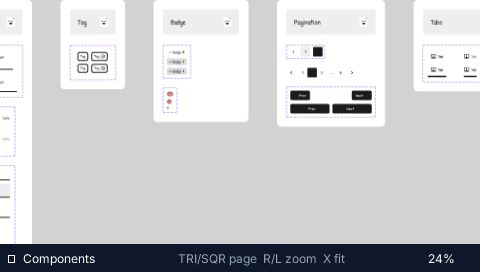
Native 480×272 output of the shipping build at 24% zoom, walking the nub up the kit's component artboards. This frame — like every PSP screenshot in this post — is the executable's own framebuffer, captured in the deterministic emulator our byte-exact tests run on.
Pocket Figma is open source at pocket-nexus/pocket-figma. And like OpenStrike before it, it exists to make a point about architecture: the device never parses, it only consumes. A design file is just the most literal possible test of that law, because a design file is nothing but things to parse.
This post is the full story: what is actually inside a .fig file — down to individual bytes — how you turn a 26,000-pixel-wide canvas into something a fixed-function GPU can stream, and why the whole thing is a pure function of the button mask.
A .fig file is a database, not a picture
Export any Figma document and you get a .fig — a ZIP with a thumbnail, the referenced images, and one opaque blob called canvas.fig. That blob opens with the magic bytes fig-kiwi, and the name is the first delight of this project: kiwi is Evan Wallace's schema format — Figma's co-founder wrote the serialization layer, published it as open source, and the file format carries his name in its header. More on him at the end.
The blob is a sequence of length-prefixed compressed chunks — and the compression is sniffed per chunk, not per file: in our kit, chunk 0 is raw deflate while chunk 1 opens with the zstd frame magic. Chunk 0 is a kiwi binary schema; chunk 1 is the document, encoded in that schema. Read that again: the file tells you how to read itself. You do not chase a version-specific spec — you decode the embedded schema with the kiwi library and get back a typed tree of everything Figma knows about the document. Here is the whole layout, from the ZIP down to a single shape's bytes — every value below is read from the real file:
One field cluster in that middle box deserves a pause. The decoded document's top level is not the shape of a document format — type, sessionID, ackID is the shape of a multiplayer update. A .fig file reads as a saved sync message: "here is everything that changed," where everything happens to be the entire document. The same protocol that lets two designers edit one canvas is what you replay when you open the file.
Here is the discovery that made this project feasible in a weekend rather than a quarter: Figma bakes its own render into the file. Every shape node carries fillGeometry and strokeGeometry — flattened path blobs where strokes have already been outlined into fills, boolean operations already evaluated, dashes already cut. Every text node carries derivedTextData: the full text layout, glyph by glyph, each with a vector outline blob in em units. We never wrote a stroker, never evaluated a boolean, never loaded a font — the hand-drawn Patrick Hand lettering renders from outlines the file itself provides. The path encoding is almost quaint: one command byte (move/line/quad/cubic/close), then float32 coordinates.
If you build on the web this pattern should feel familiar from the other direction: it is a lockfile for rendering. Figma's editor spent real CPU deciding exactly what those shapes look like; the file pins the result; any consumer — including, it turns out, a handheld from 2004 — just replays the answer.
The one thing the file does not hand you is component instances: an INSTANCE node is a pointer to its SYMBOL plus a list of overrides, and grafting those trees together correctly — a component copied between files keeps its original identity in a field called overrideKey — was the only real archaeology of the project. With that in place, the whole renderer (decode, expand, rasterize any region at any scale) comes to about 600 lines of TypeScript (tools/fig.ts) plus a canvas library, and it reproduces every page of the kit pixel-close to Figma's own thumbnails. That was the checkpoint where this stopped being archaeology and became a build pipeline.
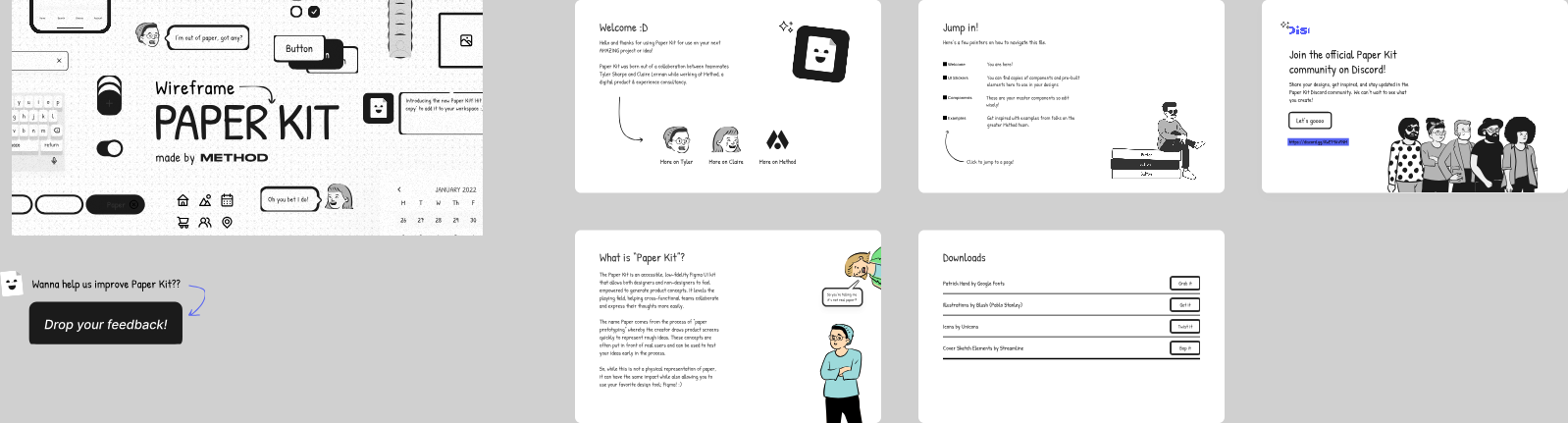
The kit's Welcome page, rendered entirely by our decoder from the file's own derived geometry — instances expanded, masks applied, glyph outlines filled. No Figma runtime, no fonts, no network.
A bundler for design files
Now the PSP part. The naive plan — ship the vectors, tessellate on device — dies on arithmetic: tens of thousands of antialiased paths per screen against a 333 MHz in-order CPU with no JavaScript JIT. The honest plan is the one every map application converged on: rasterize offline into a tile pyramid, stream tiles on demand. Google Maps, for wireframes, on a PSP.
So Pocket Figma's build step is a cooker, exactly parallel to OpenStrike's pocket3d-cook, and it bakes just as aggressively:
Three cooker decisions carry most of the weight:
- CLUT8, one palette per page. Tiles are 8-bit indices into a 256-color palette — 4× smaller than RGBA before compression, and the format the PSP's GPU natively samples through its hardware color-lookup table. A paper wireframe kit is nearly monochrome; 256 colors per page is generous enough to hold the photos too.
- Whitespace is a directory entry, not pixels. A wireframe page is mostly nothing — paper background and flat card fills. The cooker classifies every tile: background tiles vanish entirely, uniform-color tiles become a 4-byte "solid" marker in the tile directory, and only tiles with actual ink get a pixel stream (run-length encoded, because flat fills compress brutally).
- The zoom ladder is capped per page. Each page bakes at halving scales from a chosen maximum — 100% where small labels justify it (the Components sheet), 50% where they don't (the poster-sized Examples wall) — down to a level that fits one screen.
The classification is worth seeing, because it is the whole memory story in one image:
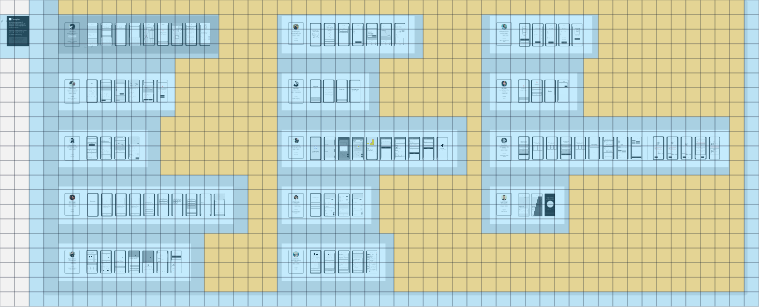
The Examples page — sixteen sections of phone mockups on a 52×21 tile grid at the finest zoom level. Blue tiles carry pixels (615). Yellow tiles are solid colors — a directory entry, zero texture memory (441). Unshaded is page background (36). 44% of the sharpest level of the busiest page costs nothing to draw.
Streaming a canvas through 2 MB of VRAM
At runtime the viewer is a new PocketJS component, <DeepZoom>, and underneath it, the engine grew the plumbing every deep-zoom canvas needs — which was the real agenda all along. Pocket Figma is the first consumer; the machinery is generic.
A few of these layers deserve a sentence. Tile churn is the fastest way to discover why texture handles need generations: pan for ten seconds and hundreds of textures are created and freed; a stale handle that silently pointed at a recycled slot would paint the wrong tile somewhere on screen, rarely, unreproducibly. Generation-tagged handles (the same trick PocketJS node ids already use) turn that whole bug class into "draws nothing." The streaming budget — two tile decodes per frame, nearest-to-center first — keeps the worst frame bounded; the pinned overview underneath means the cost of not-yet-streamed is blur, not blankness. And bilinear filtering is per-texture opt-in: the rest of PocketJS stays on nearest sampling (its byte-exact goldens depend on it), while tiles get the GE's free smooth minification between mip levels.
The result, on hardware whose entire video memory is 2 MB: a 26,000-pixel-wide artboard you can sweep across with the nub while the mip ladder swaps under your thumb.
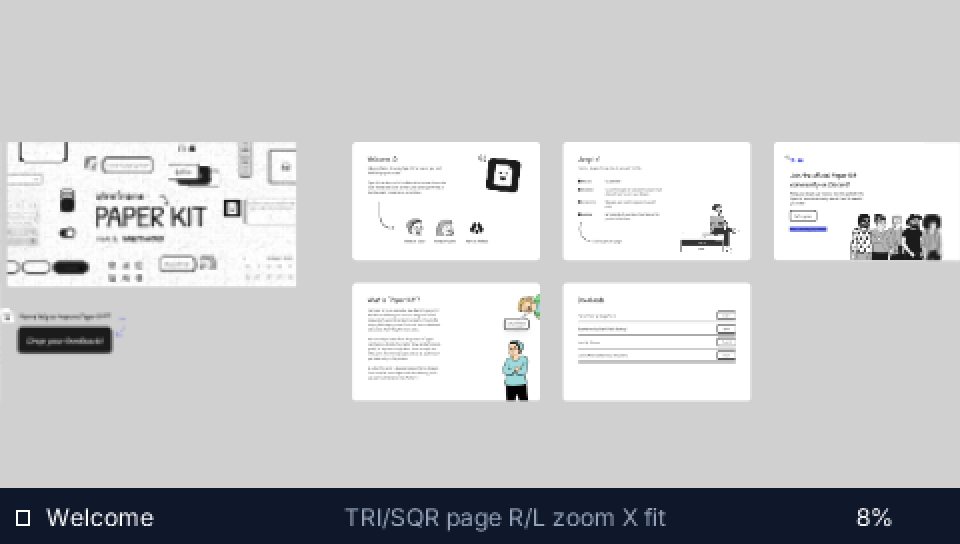
Frame 0 on the PSP: the Welcome page fit-to-screen at 8%. Every visible tile streamed from read-only memory during boot; the HUD is ordinary PocketJS text nodes.
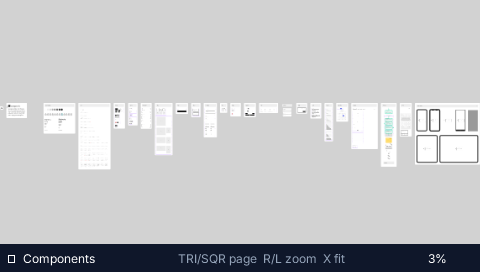
Press TRIANGLE and the Components page fits at 3%, which is what 26,000 pixels of canvas look like on a 480-pixel panel. Every artboard in that row is a tile pyramid the viewer can descend into.
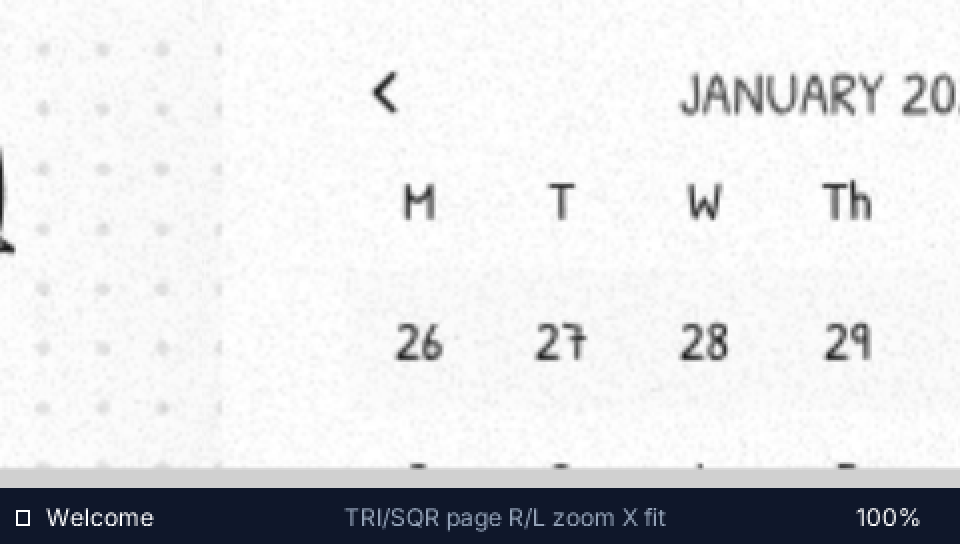
100% zoom on the kit's calendar component — Patrick Hand digits from the file's own glyph outlines, antialiased at bake time, CLUT-sampled at runtime. This capture is from the wasm reference rasterizer; the PSP's GE output of the same frame differs only in its bilinear rounding.
Anatomy of a zoom
Hold the right trigger and the zoom multiplies by 1.035 every 1/60 s tick — about ×2 per third of a second. Here is the surprise: while that happens, almost nothing happens. No tile mounts, no texture loads; the frame writes one scale prop per world and the GE redraws the same quads larger. Pan and zoom inside a level are pure transform — the machinery only wakes up at the boundaries.
The baked levels sit at ×2 spacing, and the viewer always shows the finest level that still downscales on screen: a tile is drawn somewhere between 50% and 100% of its baked size, the range where bilinear minification looks clean and never has to invent pixels. When the zoom crosses a level boundary the "ideal" level changes — but the switch waits for eight consecutive frames of agreement, because a zoom that settles right on a boundary would otherwise thrash a remount every frame. Then it commits, brutally: every tile in the active world unmounts, every texture frees, and the new level mounts its window from scratch. The screen never shows the brutality — the pinned overview world is still underneath, so the worst case is a beat of blur while the new level streams back in, center-out, two tiles a frame.
Here is that gesture as the screen experiences it — the same viewport, four moments apart:
The bookkeeping behind that picture is deliberately small: a map of mounted tiles keyed by tile index, the stream queue, and the current window rectangle — the visible tile range plus a one-tile prefetch ring. Each frame recomputes the window from the view center and zoom, and only when it changes does any mounting work happen: tiles that left are freed on the spot, tiles that entered mount blank, and the queue re-sorts by distance from the view center so the pixels you are looking at arrive first. A blank tile costs a node and nothing else; its 64 KB texture streams in from read-only memory when its turn comes. The resident set is therefore bounded by the window — about two dozen textures at PSP screen size — no matter how far you wander, and a page switch is just the same reset the level switch already rehearses every time you zoom through a boundary.
Time is still an input
Everything above obeys the determinism rules — and panning a canvas turned out to be their nicest stress test yet, because it forced a real decision. The analog nub is new input surface: the frame contract grew from frame(buttons) to frame(buttons, analog), the DevTools flight recorder now tapes the stick alongside the buttons (a centered stick adds zero bytes, so every pre-analog tape replays unchanged), and hosts without a stick just... don't pass one.
The decision was about motion. The obvious pan integrator — "each frame, move by velocity" — quietly breaks the subsampling theorem: a 15 Hz world would pan a quarter the distance per virtual second. <DeepZoom> instead integrates once per 1/60 s tick, however many ticks the host's clock policy packs into a frame. Our CI drives the same scripted journey — zoom in, nub-pan to the cover, release into the momentum glide — at 60, 15, and 5 Hz, and asserts the settled screens are byte-identical. It also re-runs the journey with random sleeps, garbage-collector churn, and allocation pressure injected between frames. Nothing changes. The wall clock is not an input; now the stick is, and it is recorded.
The same property is why we could verify the PSP build without owning a fleet of them: the emulator's deterministic software renderer dumps framebuffers, and the byte-exact e2e goldens for every pre-existing PocketJS demo passed unchanged through the entire engine surgery — new texture formats, new ops, a re-keyed GPU cache, a two-argument frame contract. Thirty-five wasm goldens, four PSP demos, zero diffs. That is what let three parallel strands of this work land in one branch without fear.
What it costs
PSP user RAM                                24.0 MB
├─ executable (engine + QuickJS + bundle
│    + all four tile pyramids)               ~8.9 MB
├─ arena (QuickJS heap, core, resident
│    tile textures ≈ 24 × 65 KB) — budget    ~4 MB
└─ free                                     ~11 MB
frame budget: JS integrator + ≤2 tile decodes + GE ≪ 16.7 ms
The shipped EBOOT.PBP is 9.1 MB — 6.2 MB of that is the four tile pyramids, and another 150 KB is the XMB art (the backdrop is the kit's own cover, rendered from the .fig). The viewer's per-frame JavaScript is a few hundred microseconds of integrator math plus at most two 64 KB RLE decodes in Rust; the GE draws a screenful of textured quads through its palette and is idle again. This machine has headroom to spare — the interesting ceiling is the Memory Stick's patience for nine-megabyte executables, not the frame.
Standing in Evan Wallace's world
A closing note, from me personally. Nearly everything this project decoded — the kiwi schema language the .fig announces itself with, the derived geometry that made a weekend port possible — is Evan Wallace's work. Five years ago, when I was first learning how collaborative apps work, his write-ups carried me further than anything else I read, and he has been a role model to me ever since: the kind of engineer who answers a hard problem by quietly building the missing piece, then telling everyone exactly how it works. Deeply understanding, and then faithfully reconstructing, a corner of the world he built — with an AI collaborator at my side — has been one of the most beautiful experiences I have had making software.
Open it
- pocket-nexus/pocket-figma — MIT.
bun run buildfor the bundle,bun run pspfor the EBOOT (XMB art included — the backdrop is rendered from the .fig itself),bun run desktopfor a windowed build. The engine layer — TILESET format, streaming ops,<DeepZoom>— lives in PocketJS. - The kit is the Paper Wireframe Kit by Method (CC BY 4.0) — the baked tiles are committed; re-baking from the .fig is one command.
- No PSP? PPSSPP runs the EBOOT as-is. Real hardware wants custom firmware and a Memory Stick with 10 MB to spare.
Follow @pocket_js for what's next. The pocket keeps getting deeper.